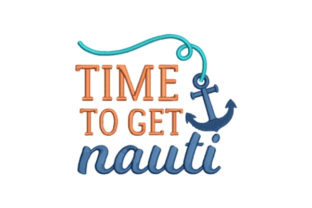
Time to Get Nauti
First Impression: Quirky, Playful, and Instantly Memorable
As an embroidery designer who’s curated over 200 craft fair booths—and sold thousands of handmade products—I’ll say it straight: Time to Get Nauti lands with cheerful confidence. It’s not elegant or minimalist. It’s not rustic or farmhouse. It’s boldly funny, lightly irreverent, and unmistakably coastal—without leaning into cliché anchors or palm trees. The phrase itself invites interaction: customers smile, say it aloud, and often follow up with, “Where’s my boarding pass?” That kind of engagement is gold at a crowded market. For the Beach category, this isn’t just another sun-and-sand motif—it’s a personality-driven machine embroidery design that stands out in a sea of predictable tropes.
Where Time to Get Nauti Shines on Craft Fair Products
In real-world booth testing, Time to Get Nauti performed strongest on items where wit meets utility:
- Tote bag design: Centered on a natural canvas tote (10–12” wide), it reads clearly from six feet away—ideal for grabbing attention as shoppers walk past.
- Apron embroidery: Placed above the pocket on a denim or linen apron, it adds charm without overwhelming the garment’s function.
- Embroidered patch: Sized at 3.5”, it stitches cleanly and transfers beautifully to jackets, backpacks, or kids’ caps—making it a high-margin, low-risk small shop product.
- Tea towel embroidery: On medium-weight cotton towels, the lettering stays legible even after repeated washing—critical for kitchen-focused buyers.
- Fabric pouch & pillow cover: Its balanced width-to-height ratio fits standard 5x7” hoops, allowing consistent batch production across multiple items.
It underperformed only when scaled too small (<4”) on curved surfaces like baseball caps—or oversized (>14”) on lightweight tea towels, where stitch density risked stiffness.
Photography, Listings, and Online Appeal
This is a strong digital embroidery file for Etsy sellers. Why? Because Time to Get Nauti photographs exceptionally well—even on phone cameras. The phrase has built-in contrast (uppercase “Nauti” vs. lowercase “time to get”), giving mockups visual rhythm. When layered over a soft blue background or styled beside a vintage suitcase and sunglasses, it reads as both handmade and intentional. For printable mockup use, it holds clarity at 72 dpi previews and scales cleanly to 300 dpi for print catalogs. Bonus: its playful tone encourages customer tags and shares—boosting organic reach for small shop owners.
Production Realities: What You Must Test Before Booth Day
Don’t skip these steps—even if the embroidery file looks perfect in your software:
- Test on scrap fabric matching your final product (e.g., terry cloth for towels, twill for caps).
- Check thread contrast: Light thread on dark fabric may fade the humor; navy thread on cream linen keeps readability sharp.
- Review spacing between letters—tight kerning can blur on textured towels or thick stabilizer.
- Confirm hoop size compatibility. If your machine requires re-hooping mid-stitch, factor in time loss during batch runs.
- Inspect stitch density. Dense fills in “Nauti” could pucker thin cotton—opt for light tear-away + cut-away combo on delicate fabrics.
- Use the right stabilizer: Medium-weight cut-away for caps, lightweight tear-away for tea towels.
- Create at least one real mockup—not just digital. Hold it in natural light. Does it pop? Does the humor land?
- Compare fabric colors: A warm beige linen reads differently than oatmeal cotton—subtle shifts affect perceived quality.
- Confirm commercial licensing before selling finished products. Since the description says “can b” (likely “can be used commercially”), verify terms directly with the designer or platform.
Careful-Use Notes for Handmade Sellers
Time to Get Nauti includes tight curves and compact lettering—so keep these in mind:
- Avoid stitching it smaller than 3” wide on textured towels or terry cloth—the “u” and “t” may merge visually.
- On dark fabric, use matte-finish thread (not rayon) to prevent glare that obscures shape.
- Cap embroidery demands precise digitizing for curve compensation—don’t assume the file auto-adjusts.
- Dense areas (especially the “a” and “i”) may require reduced top tension or slower speed on older machines.
- For commercial embroidery clients, clarify whether they need PES, DST, JEF, or EXP formats upfront—multiple formats are listed, but confirm which match their equipment.
Why Time to Get Nauti Strengthens Your Booth & Brand
At a craft fair, your table competes with glitter, scent, and noise. Time to Get Nauti cuts through because it’s conversational—not decorative. It invites questions, stories, and selfies. Buyers don’t just purchase a tote—they buy a vibe, a memory, a tiny act of rebellion against “adulting.” That emotional hook elevates perceived value: you can price it 15–20% higher than generic nautical motifs without hesitation. As a handmade product, it signals confidence in your curation—not just skill in stitching. And because it works across categories (kitchen, apparel, accessories), it unifies your display while feeling fresh each time.
Final Thought: A Smart, Repeatable Craft Fair Bet
Time to Get Nauti isn’t a one-off novelty. It’s a versatile, mood-lifting embroidery asset that supports repeat sales, cross-merchandising, and brand storytelling. For Etsy sellers, it’s list-ready. For boutique makers, it’s shelf-worthy. For Cricut and embroidery crafters, it’s a joyful pivot from holiday-only designs. Just remember: its strength lies in clarity, contrast, and context. Stitch it thoughtfully—and let the cruise begin.