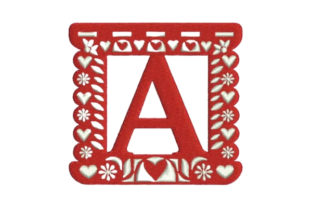
Papel Picado Alphabet A
A Thoughtful Embroidery Designer’s Review for Small Business Branding
As an embroidery designer who’s developed hundreds of commercial designs for cafés, boutiques, bakeries, florists, and handmade studios, I approach every new machine embroidery design with two questions: Does it translate authentically into real-world merchandise? and Will it strengthen—rather than dilute—a small business’s brand identity? That’s why I took Papel Picado Alphabet A seriously—not as a decorative flourish, but as a functional, scalable brand asset. Its roots in Mexican folk art immediately signal warmth, craft, and cultural authenticity—valuable traits for any small business seeking emotional connection over generic branding.
First Impression: Handmade Charm Meets Commercial Clarity
Papel Picado Alphabet A feels intentionally handmade yet precise—a rare balance. The delicate cutwork-inspired outlines evoke traditional papel picado banners, but the letterform remains legible and structurally sound for embroidery. It reads as friendly and approachable without sacrificing elegance; rustic enough for a neighborhood bakery apron, refined enough for a boutique tote bag or studio cap front. It avoids the pitfalls of overly ornate monograms: no fragile filigree, no un-embroiderable negative space, and no visual clutter that competes with a business name or tagline. For small business merch, that clarity is non-negotiable.
Where Papel Picado Alphabet A Shines in Real Business Use
This machine embroidery design excels where small brands need subtle distinction: on staff uniforms, custom apparel, and product-adjacent items that reflect care and consistency.
- Embroidered patches: Works beautifully as a standalone 2"–3" chest patch for café aprons, florist smocks, or pet brand jackets—its openwork style reads clearly even at moderate sizes when stitched with quality thread and stabilizer.
- Cap embroidery: Performs well on structured front panels (not curved crowns), especially with medium-density stitching. Its clean silhouette avoids distortion on standard cap hoops.
- Tote bag design & apron embroidery: Adds artisanal credibility without overwhelming. Paired with minimal text (e.g., “Brew & Bloom” or “Casa Flores”), it anchors the composition while reinforcing a handmade product ethos.
- Product packaging accents: Ideal for embroidered labels on linen tea bags, ceramic gift boxes, or fabric-wrapped soap—small-scale applications where personality matters more than prominence.
- Etsy branding & craft business assets: Serves as a cohesive visual signature across digital embroidery file listings, printable mockups, and physical product tags—helping Etsy sellers stand out in saturated categories like “Mexican-inspired embroidery” or “small batch apparel.”
Use With Intention: Where to Proceed Cautiously
Papel Picado Alphabet A is not universally scalable—and that’s okay. As a designer, I advise caution in these scenarios:
- Under 1.5" embroidered patches: Fine interior details may collapse or become indistinct. Always test stitch at your target size before bulk production.
- Cap fronts with high curvature or low-profile foam fronts: May require digitizing adjustments—consult your digitizer if using for large-cap runs.
- Dark uniforms or textured fabrics (like heavy canvas or terry cloth): Requires careful thread color selection and stabilizer pairing. Light-colored threads (ecru, soft white, pale terracotta) often enhance its folk-art feel better than stark black.
- Frequent-wash items (e.g., daily-use aprons or work shirts): Confirm stitch density supports durability—overly dense fills can stiffen fabric; overly sparse outlines may snag. Balance breathability with longevity.
How It Shapes Brand Identity—and Why That Matters
Papel Picado Alphabet A does more than spell “A.” It quietly communicates values: craftsmanship, cultural resonance, attention to detail, and human-scale production. For a local business, that builds trust faster than a stock sans-serif logo ever could. Customers recognize authenticity—not just in what you sell, but in how your brand *feels* when touched, worn, or gifted. An embroidered Papel Picado Alphabet A on a tote bag tells a story before a word is read. On a staff apron, it signals pride—not just in service, but in shared aesthetic language. And for Etsy sellers or craft businesses, it reinforces consistency across design assets: one cohesive thread running from digital embroidery file to finished product to social media mockup.
Practical Notes Every Embroidery Designer (and Small Business Owner) Should Follow
Before committing Papel Picado Alphabet A to client work or inventory, here’s my checklist—refined over 12 years of commercial embroidery:
- Test stitch in black and white first—assess contrast, spacing, and edge definition before selecting final thread colors.
- Verify performance at your smallest intended patch size—don’t rely solely on preview images.
- Review spacing between interior cutouts and outer edges—tight gaps may close up on low-stitch-count machines or dense fabrics.
- Confirm hoop size compatibility with your primary embroidery machine(s); some multi-format files assume standard 4x4 or 5x7 hoops.
- Test on your actual fabric—especially textured, stretchy, or loosely woven materials—to evaluate stabilizer needs (cutaway works best for stability; tear-away suffices for stable cottons).
- Create a printable mockup for client approval—show it alongside their brand palette and typography to confirm visual harmony.
- Compare Papel Picado Alphabet A beside other design assets (e.g., full logos, secondary icons) to ensure stylistic cohesion—not just thematic alignment.
- Confirm commercial licensing terms before use on merchandise sold to end customers. Since this is marketed as a machine embroidery design for fabric and clothing, verify scope—especially for resale or wholesale applications.
Papel Picado Alphabet A isn’t just another letter—it’s a bridge between heritage craft and modern small business needs. When used intentionally, it elevates aprons, caps, totes, and patches from functional items into meaningful brand touchpoints. For embroidery shops, apparel decorators, and creative studios building identity one stitch at a time, it’s a thoughtful, culturally grounded choice—one that honors Mexico’s papel picado tradition while serving today’s demand for authentic, scalable embroidery.